Economic data today: Bain survey puts price first for US car buyers
Bain's Global Automotive Consumer Survey finds price leads in the U.S. (68%) and Europe (62%), while tech and features top China at 58%. Key figures inside.
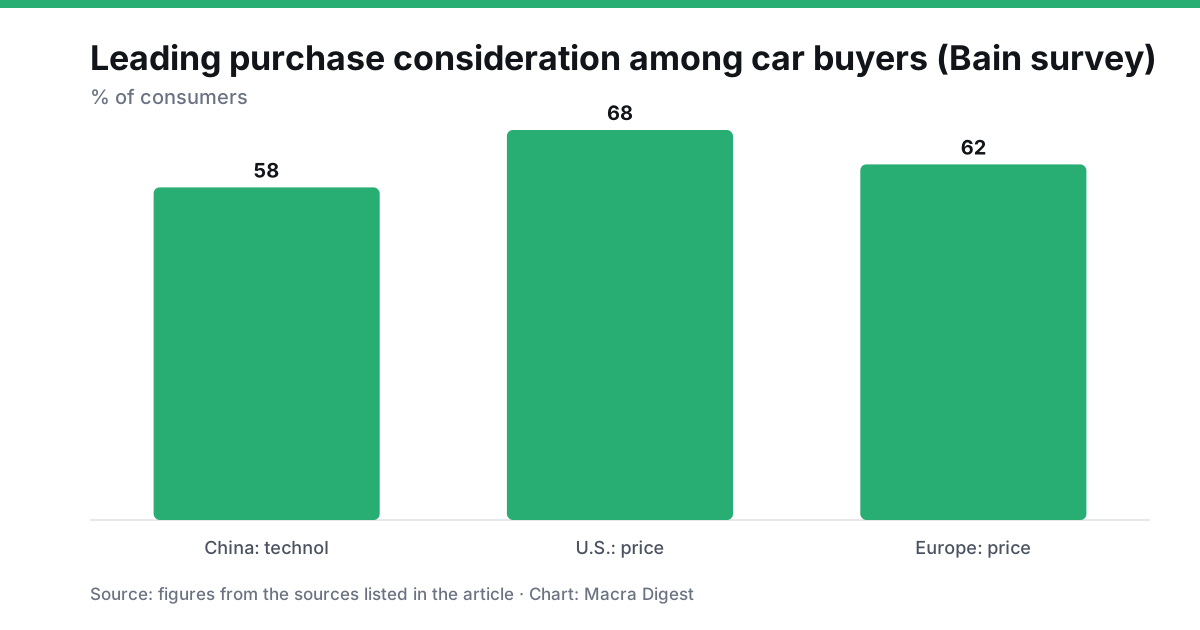
| Market | Leading purchase consideration | Share of consumers |
|---|---|---|
| China | Technology and features | 58% |
| United States | Price | 68% |
| Europe | Price | 62% |
Source: Bain & Company, Global Automotive Consumer Survey, as reported Oct. 20, 2026.
Economic data today: car buyers want both price and technology
Consumers in three major car markets are asking automakers for more at a lower price, according to the latest Global Automotive Consumer Survey from Bain & Company. Price is still the leading purchase consideration for 68% of U.S. buyers and 62% of European buyers. In China, technology and features led for 58% of consumers, ahead of price.
The survey is a consumer-demand indicator, not a sales release. It adds context to car-price and spending data that appear on the economic calendar, since vehicle affordability feeds into household budgets and inflation readings.
Price is a precondition
Bain executives said the Chinese result does not mean buyers have stopped caring about cost. Intense domestic competition has made low prices an expectation there, which pushes carmakers to differentiate on technology and features. “Competitive price is basically a precondition to be in consideration of the customer,” said Klaus Stricker, who leads Bain’s Global Automotive & Mobility practice.
Stricker expects Western markets to follow, with competitive pricing becoming a baseline and technology playing a larger role in decisions. He also expects growth in Chinese manufacturers’ presence to intensify pricing pressure in Europe.
Chinese exports and weakening loyalty
Customs figures cited by the China Passenger Car Association show Chinese vehicle exports to Italy more than doubled to 209,258 units in January to August. Shipments to the U.K. rose about 86% to 365,672 units.
Brand loyalty is weakening alongside it. Stricker said European manufacturers built their business model for decades on loyalty, but the survey found more than a third of customers in Western markets are open to new brands entering the market. Buyers most interested in autonomous-driving technology are also more willing to switch manufacturers for better functionality.
Helen Liu, Bain’s Asia automotive head and partner, said younger U.S. and European consumers are closer to Chinese buyers in their openness to technology. She said Western manufacturers need to “up their game” to keep those customers.
Monetizing features
Turning technology into revenue is the sticking point. Stricker said mass-market buyers often expect advanced driving technology to be included, without a substantial premium. Liu said that leaves Chinese and Western carmakers “climbing different mountains”: emerging Chinese players must build their brand standing, while Western incumbents must strengthen their technology offerings. All players must keep prices competitive.
Bain’s conclusion is that manufacturers who close their respective gaps without pricing themselves out of consideration stand to gain the most as the industry consolidates.
What to watch
Readers following the economic calendar can pair this survey with the next releases that cover consumer prices and retail sales, where vehicle prices appear in the totals. The Bain figures indicate that price sensitivity in the U.S. remains high, while the share of buyers open to new brands suggests more competition for incumbents’ customers.
Prepared with AI assistance from public sources and reviewed under our editorial policy. Not investment advice.