GDP Report: Q3 Growth Revised to 4.3% as PCE Inflation Hits 3.8%
Economic data today: BEA's second estimate puts Q3 GDP growth at 4.3%, October income rose 0.7% and saving fell to 4.1%, while CNBC reports PCE inflation at 3.8%.
| Indicator | Reading |
|---|---|
| Real GDP, Q3 2026 (second estimate, annualized) | +4.3% |
| Real GDP, Q2 2026 | +2.2% |
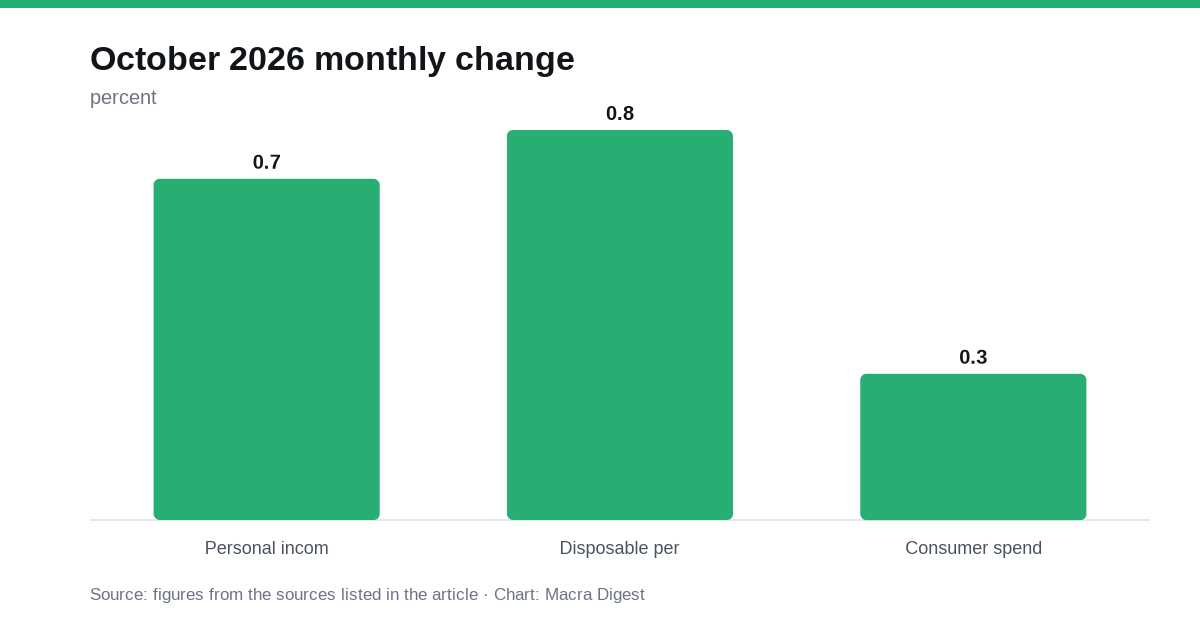
| Personal income, October | +0.7% (+$201.8 billion) |
| Disposable personal income, October | +0.8% (+$200.5 billion) |
| Personal consumption expenditures, October | +0.3% (+$63.8 billion) |
| Personal saving, October | $1.00 trillion |
| Personal saving rate, October | 4.1% |
| Fed’s preferred inflation gauge, October (per CNBC) | 3.8% |
Wednesday’s economic calendar delivered the delayed third-quarter GDP report and October income and spending figures together. Growth was strong, incomes rose faster than spending, and the Fed’s preferred inflation gauge accelerated, according to CNBC.
Key takeaways
- Real GDP grew at a 4.3% annual rate in Q3, up from 2.2% in Q2, according to the Bureau of Economic Analysis (BEA).
- October personal income rose 0.7%, more than double the 0.3% increase in consumer spending.
- The saving rate was 4.1%, with personal saving at $1.00 trillion.
- CNBC reports the Fed’s preferred inflation gauge accelerated to 3.8% in October, raising the stakes for the central bank in 2027.
GDP report: third-quarter growth at 4.3%
The BEA’s second estimate shows real gross domestic product rose at a 4.3% annual rate in the July–September period. That is roughly double the 2.2% pace recorded in the second quarter.
Investment, consumer spending and government spending all contributed to the gain. A decline in exports partly offset them. Imports, which subtract from GDP, increased.
The release also covers corporate profits for the quarter. The summary figures available do not include a profit number, so that detail is left for the full BEA tables.
October income and spending
Personal income rose $201.8 billion, or 0.7%, in October. Disposable personal income, which is income after personal current taxes, rose $200.5 billion, or 0.8%.
Personal consumption expenditures increased $63.8 billion, or 0.3%. Total personal outlays, which add interest payments and transfer payments to consumer spending, rose $69.3 billion.
Because disposable income grew much faster than spending, households kept more of what they earned. Personal saving came to $1.00 trillion, and the saving rate stood at 4.1% of disposable income.
Inflation gauge accelerates
CNBC reported that the Fed’s preferred inflation gauge accelerated to 3.8% in October. The outlet framed the reading as raising the stakes for the central bank heading into 2027. Inflation of that size is well above the levels the Fed has aimed for, and it arrives alongside strong growth and rising incomes.
In a separate commentary, CNBC’s Steve Liesman argues that Kevin Warsh needs to hike rates, and contrasts that with the case for betting on productivity gains, as Alan Greenspan once did. The piece is opinion, not a policy signal. It does show how the debate over rates, artificial intelligence and inflation is developing.
Consumers and the global backdrop
CNBC also reports that price increases are reaching items such as toys, and that Americans are scaling back holiday plans. That fits a picture in which headline spending is positive but households are watching their budgets. Rising prices for travel, food and gifts are part of the same story, according to the outlet.
Abroad, CNBC reports that the United Arab Emirates’ economy minister sounded optimistic as the International Monetary Fund lifted its forecast for the country. The minister said the UAE is ready for any storm.
What to watch next
The next steps are the third estimate of Q3 GDP and the following inflation reports. Readers should watch whether the 3.8% inflation reading is confirmed by other price measures, and whether stronger incomes lead to faster spending. They should also watch how Fed officials describe the trade-off between solid growth and elevated inflation.
Prepared with AI assistance from public sources and reviewed under our editorial policy. Not investment advice.